

Q & A: Laurent Pelly on 'Il Turco in Italia' at the Teatro Real de Madrid & Why He Prefers Comedies to Tragedies
By Mauricio Villa
Excerpted with permission from OperaWire
French stage director Laurent Pelly is one of the most prolific and renowned stage directors today. Many of his productions are still being performed after premiering 20 years ago. He is a specialist in French repertoire and comedy. He also designs the costumes of his creations. His productions can be seen all over the world from Japan and Europe to USA, and are available in DVD/Blu-ray.
Pelly spoke with OperaWire minutes before the general rehearsal of his new production, "Il turco in Italia" by Rossini at Teatro Real, Madrid.
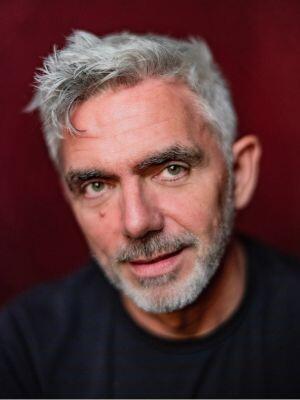
Laurent Pelly
―You founded a theatre company called "Compagnie Theatrale du Pelican" when you were just 18-years-old. Did you study to become an actor or a director?
Yes, I definitely wanted to become a stage director when I was 18. This passion came when I was about 14 or 15-years-old. My parents always took me to the theatre, since I was very young. I was really attracted to the world of theatre. I found opera much later in my career, and founded my own company when I was 18. I began my career directing and doing assistant theatre director jobs. I met the director Jean-Louis Martin Barbag, who had been my drama teacher, with whom I collaborated in several theatre productions and who suggested me to direct plays at the Le Centre Dramatique National des Alpes (CDNA). I was about 21-years-old and that's how my career began. He was the director of the company and put me in charge of very important theatre projects.
―How did directing opera come into your life?
I have always been interested in music. I sang in a choir when I was little and throughout my adolescence. I always integrated music in my creations, live music with a small orchestra and actors who could sing. My first encounter with opera happened when I was twenty-four or twenty-five years old. I had already become director of the CDNA, and Marc Minkowski had just been named principal conductor of the "Grenoble Chamber Orchestra." The director of the "Opéra National de Lyon" Jean Pierre Brosman decided to put both of us in charge of a new production of "Orphée aux enfers" with Natalie Dessay, and we have done my productions together since then. So, I might say that it just happened by chance.
Our second opera production was "Platée" by Jean-Philippe Rameau, at the Opéra national de Paris in 1999, where Mikowski was the principal conductor. Marc proposed this rarely performed title, and by chance, the director and production which were in charge dropped out. Marc proposed me and the production was a huge success. We just made a revival last year and it has been performed throughout 25 years. Brosman was then director of the "Théâtre du Châtelet" in Paris and re-joined Marc and me again to do "La Belle Hélène" by Jacques Offenbach, and thanks to this production my international career began. I started working in the United States, Japan and all over Europe.
― Due to the vast amount of French opera titles you have staged, you are considered a French specialist. In fact, you are probably the stage director who has done the most Offenbach operas. Is this by chance? Or do you have a special interest in this French composer?
I have done 14 Offenbach works, "La Belle Hélene," "La vie parisiene," "Les contes d'Hoffman," "La grande-duchese de Gerolstein," and "Barbe bleue." I have done two different productions of "La périchole." I have a special attraction for comedy and Offenbach is magnificent, funny, and a little bit crazy. So, I feel a special connection with this composer. I have staged his minor works as well as his major works.
―Offenbach has generally been underrated and despised by musicologists and other composers who considered his music simple and commercial. Do you agree with this statement?
To me, the French operettas are like Rossini's opera buffa and not minor compositions. I strongly believe the stories and librettos of most of them are strong and consistent. It is true that even in France the Operettas are considered a subgenre. But Offenbach's music is, in my opinion, extraordinary, has rich orchestrations, and is full of poetry. It is strong and dramatic. Those qualities outshine Offenbach from other Operetta compositions. It is comedy, but with strong characters and a social message.
―The dance in your productions is very noticeable, especially for the choir. Do you choreograph yourself, as most of the times there is no choreographer named in the program, like in your current production of "Il Turco in Italia?"
Yes, absolutely. I love working with the choir. I don't have a dancing or choreography background. I don't have the technique. So, I do sometimes work with an Italian choreographer, Laura Scozzi. But all the dancing of the choir in my production of "La fille du regiment" is my work.
―If we take a look at your trajectory, we can see more comic operas than dramatic works. Is this your choice?
Absolutely. It is my choice. I have had my try lately in drama works like "La Traviata" and "I Puritani." But I don't enjoy working in those operas as much as in the comedy ones. Comedy is my comfort zone, and I have the chance today to choose the operas I really want to work with. I adored the fantasy, the magic, and the poetry, and I can't find these elements in serious operas. I have been offered repertoire titles like "Madame Butterfly" but I don't think this opera is for me. It is essential for me to be able to play during rehearsals, to find plaisir in the music and the libretto. "Les contes d'Hoffmann" can't be considered a comedy but it is full of magic elements, and I love that. This is another production that has been revived for years. We have done it in Lyon, Japan, San Francisco, Chicago and it is currently in the repertoire of Deustche Opera after 20 years.
―You have been creating a new production of "Il Turco in Italia" for Teatro Real, which will premiere May 31st. What can you tell me about your ideas and concept?
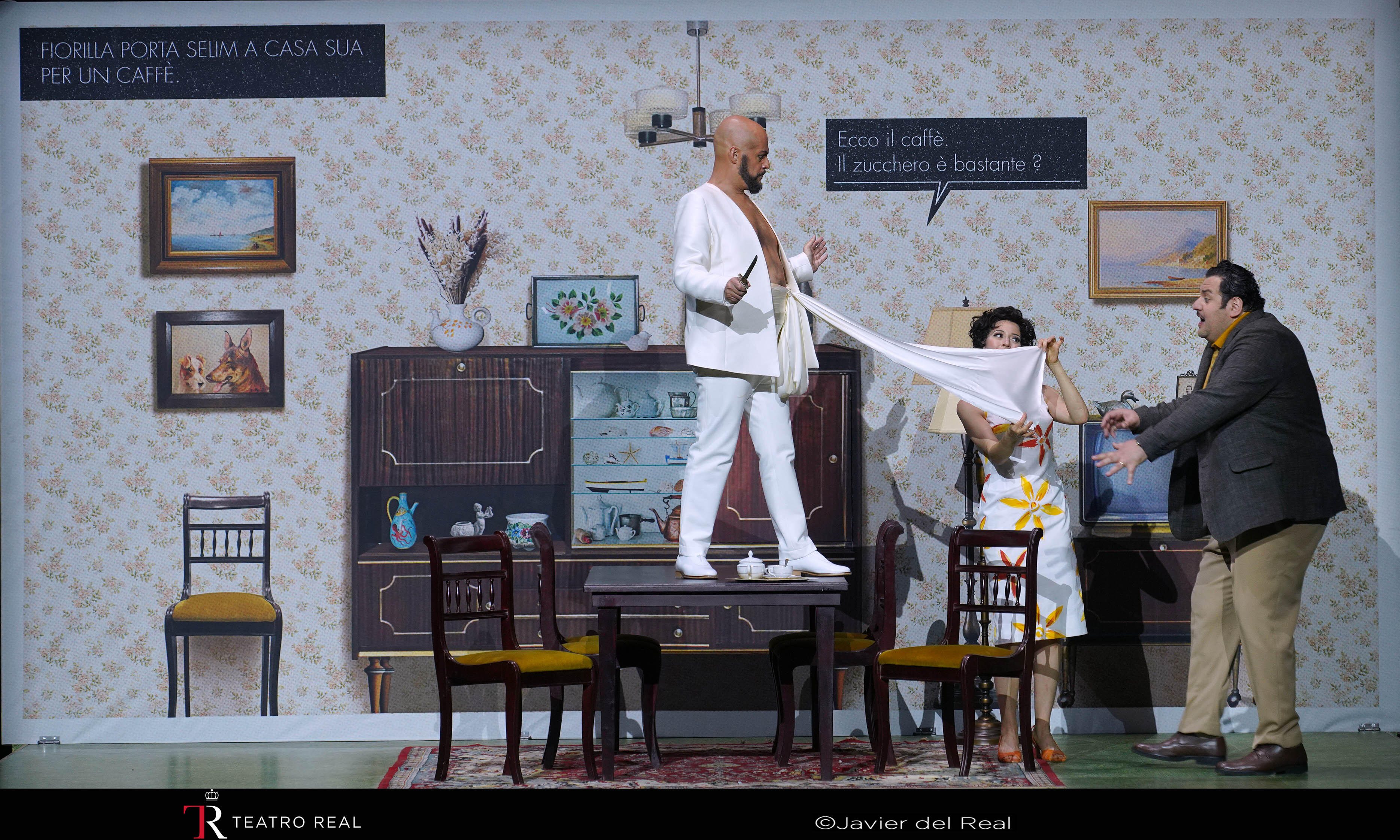
© Javier del Real | Teatro Real
This is my fourth Rossini title. I love this composer, but it is very demanding for the staging. All the Bel canto titles are, because the music and the voice become essential, leaving the story and dramatic arch behind. My point of view is that Rossini's music is very challenging for the singers because of the coloratura, so that leaves the singers more focus on technique rather than on acting. And if we look at the role of "Fiorilla," it is monstrous. It is extremely long. She sings three quarters of the opera, and she has the most difficult aria at the end of the evening. But I find it difficult to make a character believable when the arias and ensembles keep repeating the same words all the time. In my opinion, Rossini writes "mad music." There is fantasy and it is hilarious. It is frenetic. But if we look at "Il Turco in Italia" the story is classical and traditional.
It is the story of an unhappy married woman who dreams about pleasure, enjoyment and freedom. But in the end she is going to accept her situation of a submissive woman who renders to her husband. How can we tell this story today? Because I believe that my work is to present the stories to a modern audience. But after decades of fighting for women rights, for example, what is the point in presenting this story today? I always think about people who go to the opera for the first time. So, it is essential to do a re-lecture of the work to present this libretto to the audience today and make it believable and interesting.
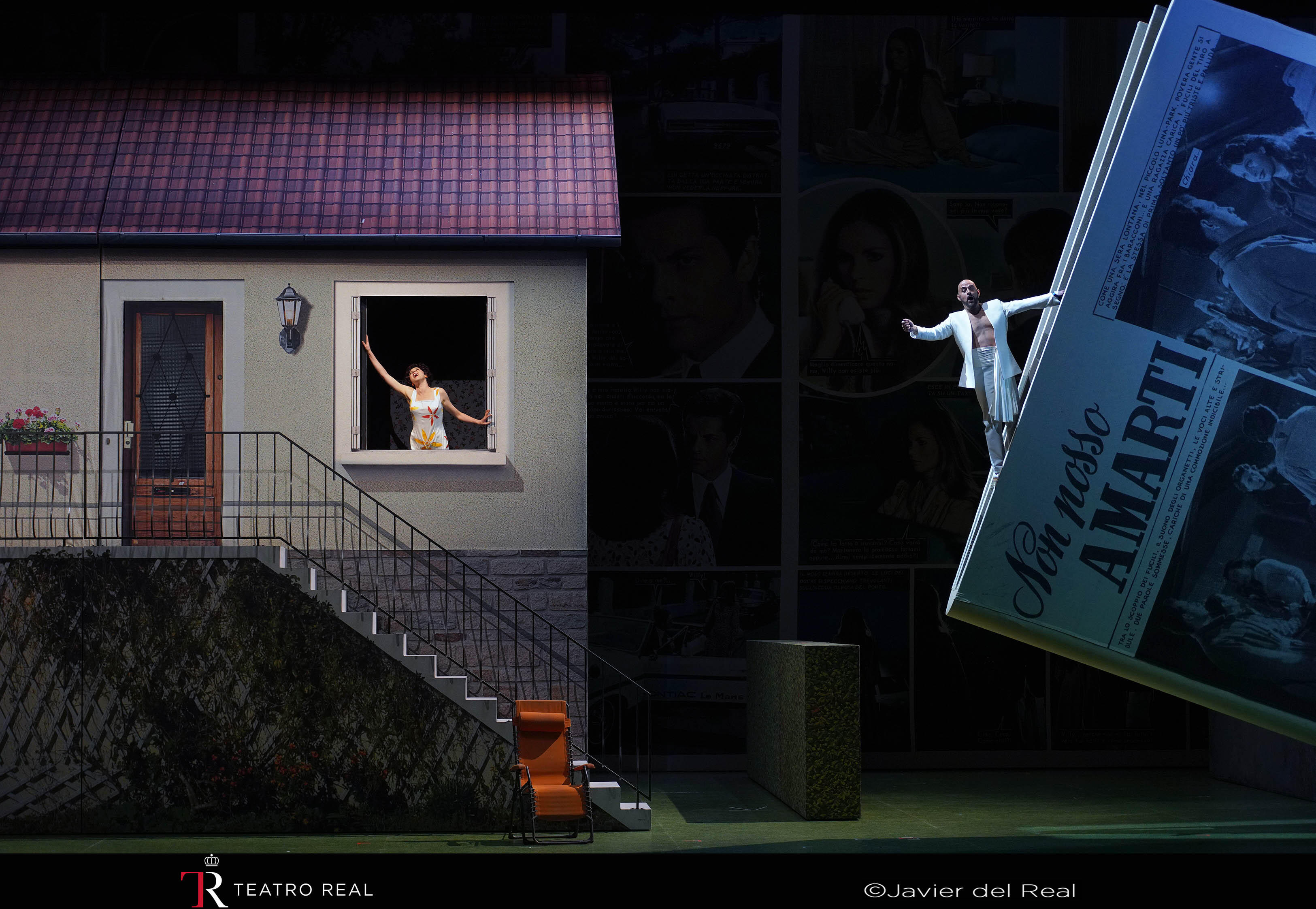
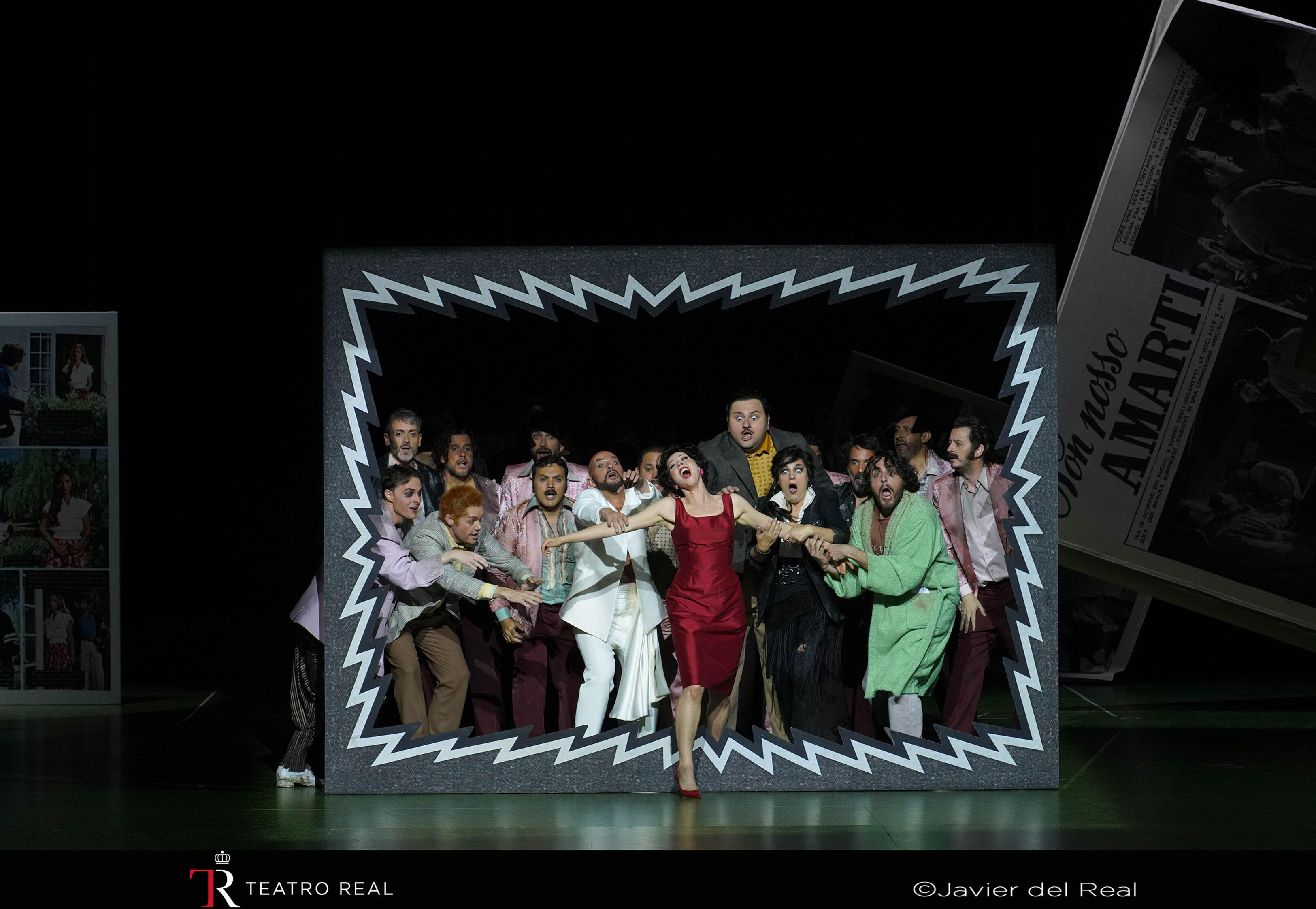
So, I find this burlesque comical couple, the young Fiorilla unhappy married with the old Don Geronio, with this phantasmagorical figure of "Il Turco" who appears suddenly with his exotic charisma. And somehow this made me think of Fellini's movie "Lo sceicco bianco." It is the first black and white Fellini movie, and it tells the story of a woman who is obsessed with photo novels. And I found my inspiration for this opera too, in Woody Allen's film "The purple rose of Cairo" which tells the story of a woman who attends movie theatres to constantly escape from her abusive husband, and at some point the characters of the movies she watches become alive and get out of the screen. So, I discussed these ideas with my set designer Chantal Thomas and we found this universe of photo novels where Fiorilla is lost and where this phantasmagorical and sexual Turk comes alive. Photo novels were in between comics and cinema and I found that Rossini's Bel canto music with all the repetitions of the same discourse for the coloratura could be easily placed inside the frames of empty photo novels where the characters of the opera get in and out throughout the action of the opera.
And this melodrama of the Turk who arrives in Italy to meet by chance her own lover who had fled from his Harem could only be explained in this photo-novel context. And it really works. I can reflect the burlesque, parody, and melodramatic elements of this opera, and make them believable and interesting for the audience today. And I have to say that all the members of the cast work enthusiastically accepting my concept and made it come alive.
― Finally, which opera would you like to do that you haven't done yet? And which opera would you never want to direct?
I would definitively never do serious Bel-canto operas. I have done "Lucia di Lammermoor" but I always felt it wasn't an opera for me. I was lucky to have Brenda Rae and Michael Spyres for the debut of the production in Philadelphia. They are two amazing actors/singers and I was happy with the result. But in revivals where I had extraordinary singers who were focused just on their vocal interpretation, I found that my production was lost. If the singers don't understand that they have to find the drama in the music, the essential theatrical communication is lost. Anyway, serious operas are not for me.
Then again the problem with repertoire operas like "La Traviata," "La boheme," and "Carmen" is that they have been staged so much that the usual director approach today would be to ask, "what can I do?" "What has not been done before, with this opera?" And I believe that everything has already been done. When I work in less known titles, I can put all my senses and heart on the score and the libretto. When I work in theatre companies, I always choose less known or new plays, rather than the repertoire ones.
And I am really interested in 21st-century compositions. I would love to do "Le gran macabre," Poulenc's "La voix humaine" and new creations. And I get to stage the new "Die Meistersinger von Nurnberg" next year at the Teatro Real. That will be my first encounter with Wagner. Joan Matabosch, the director of Teatro Real, insisted firmly that I direct this opera. I thought it wasn't for me. But he was right. The music is amazing and it is an excellent comedy. It will be a brand-new experience for me. A comedy that is five-and-a-half hours long.
© Javier del Real | Teatro Real
© Javier del Real | Teatro Real
Gioachino Rossini ❝Il Turco in Italia❞
On Stage 2, 4, 7, 10, 12 October
See here for more information.